
4 September 2026
Four grants to build Welsh AI’s foundations
Wales is investing in data, maps, open knowledge and language infrastructure — four complementary areas that can help Welsh flourish in the AI age.
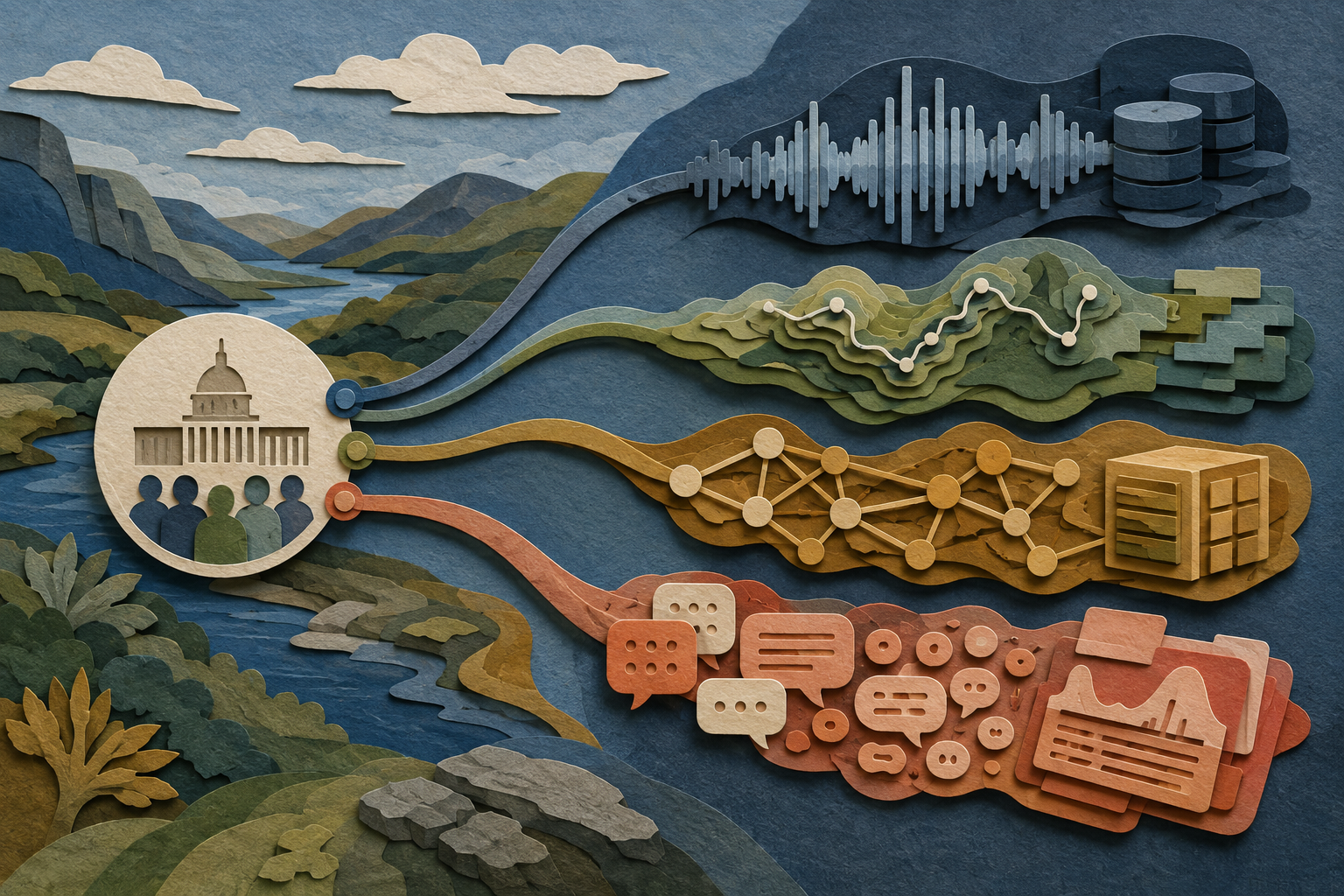
Four complementary areas of work
The Welsh Government update page, updated on 1 September, confirms four Welsh technology grants for 2026–27.
- Bangor University to deliver Iriaith, developing and improving Welsh data, AI models and technology tools.
- Data Orchard to deliver Mapio Cymru, developing and enriching open Welsh geographic data.
- The National Library of Wales to deliver Wici Cymru a’i Phobl, expanding Welsh content and knowledge through open data and wiki platforms.
- Cardiff University to develop, deploy and integrate CyTag NLP Cymru services, building new language-technology infrastructure.
The projects will report progress and results at the end of March 2027. This gives the programme a clear milestone and an opportunity to share tools, data and lessons arising from the investment.
The project AIsteddfod’s July summary already recorded ongoing Iriaith and Mapio Cymru work. The new update gives the full 2026–27 picture, adding Wici Cymru a’i Phobl and the specific focus on CyTag infrastructure to the site’s record.
From tools working today to tomorrow’s infrastructure
This is not investment only in distant ideas. The official update gives examples of Welsh technology already in use. The Welsh Language Commissioner’s office uses Teams transcription and Copilot to help with meeting minutes; the press office uses Trawsgrifiwr with human transcript checks; and the Senedd constituency map uses Mapio Cymru’s work.
These examples show a path from research and data to everyday use. When a Welsh resource is open and reusable, another organisation can turn it into a new service without starting again.
Considered together, the four grants look particularly promising: Iriaith can strengthen foundational data, models and tools; Mapio Cymru can make Welsh place names and geographic knowledge available in Welsh; Wici Cymru a’i Phobl can expand Welsh knowledge for people and systems; and CyTag can provide text-processing services for other tools.
This is our inference from public descriptions, not a description of a formal integration plan. But the potential is clear: Wales is investing in several parts of language infrastructure rather than one standalone app.
The value of each grant and final output details have not been published on the update page. That is natural at the programme announcement stage. March’s reports will offer a chance to see the resulting datasets, services, licences and success measures.
An encouraging lesson from Armenia
An encouraging example from another language arrived this week. From Zero to Hero: An Open LLM Ecosystem for Armenian, a preprint submitted on 3 September, shows what can happen when data, models and related tools receive investment together.
The work connects ArmWeb, 4.37 million Armenian news documents; ArmSTEM, 373,000 English–Armenian mathematics and science problems; and arm-gemma-e4b, a 9-billion-parameter Gemma adaptation with its training recipe and code.
According to the model card, the average across six Armenian tasks rose from 0.477 to 0.499, and Belebele from 0.619 to 0.716. The experimentation itself was productive: the team showed that news-only data could improve fluency while weakening knowledge, then found that adding 6% translated and verified STEM data reversed the loss.
The team also checks training/test overlap. That helps others understand why scores rose and build on the work confidently.
This is a base model, without instruction or safety fine-tuning, and the weights use the Gemma licence. Nevertheless, the Armenian collection shows the value of connected resources: a corpus, parallel data, model, training method and evaluation in one package.
This suggests Welsh projects could also benefit from complementing one another. Iriaith, Mapio Cymru, Wici Cymru a’i Phobl and CyTag offer different parts of similar infrastructure, adapted to Welsh needs and strengths.
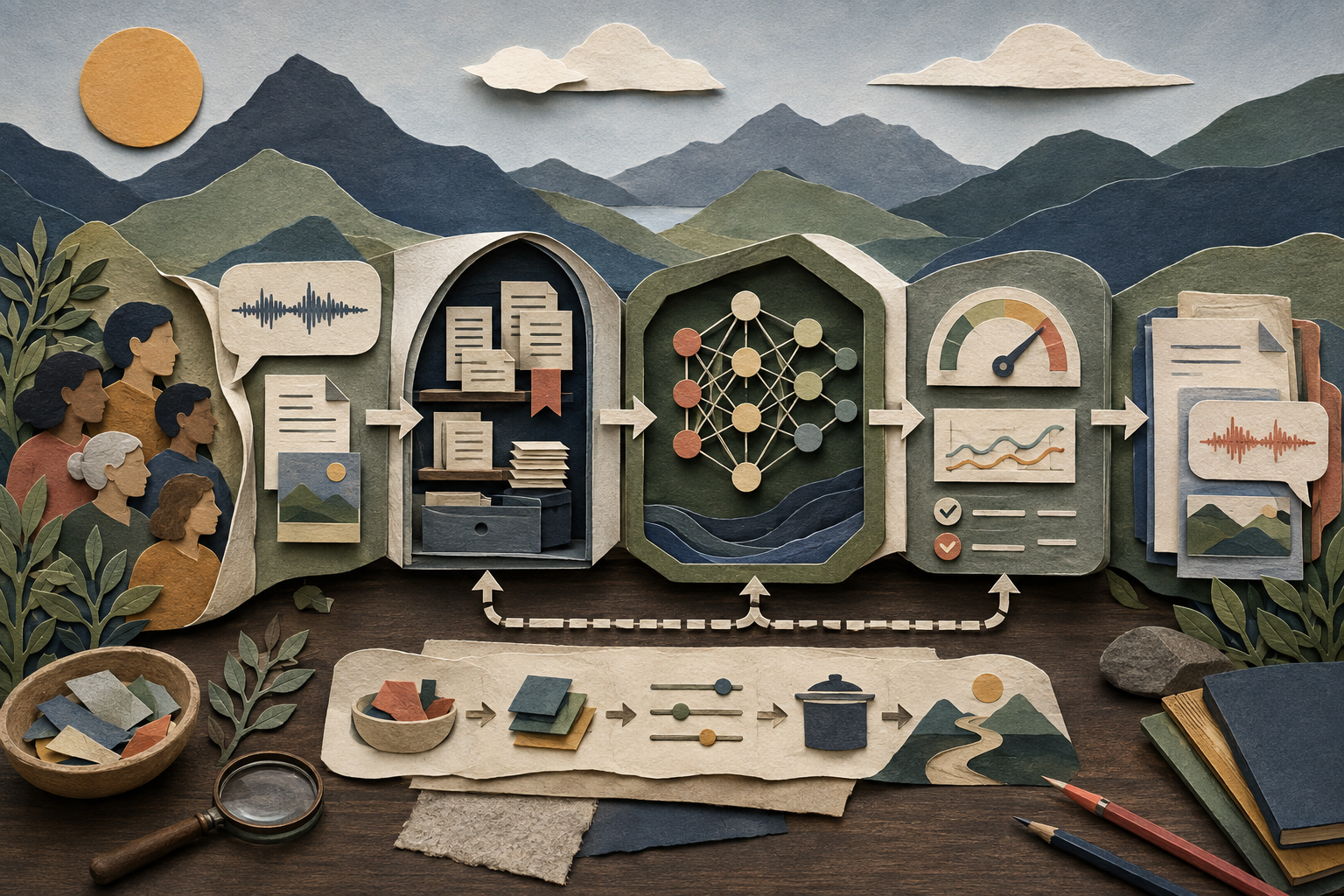
Two practical ideas from Nepal
Arkios, a bilingual Nepali–English model with 1.04 billion parameters, offers a useful idea for evaluating Welsh. On Belebele, it scored 0.240 in Nepali and 0.236 in English when required to answer with a letter—close to the 0.250 expected from guessing in either language. When the answer text itself was scored, the results rose to 0.306 and 0.387.
The bilingual test helped the team see that answer format was part of the problem, not just Nepali. Welsh projects can use the same principle: test the same task in Welsh and English, in more than one format, to understand exactly where progress is happening.
SpeakPay shows how far a small, targeted dataset can take us. On 403 Nepali financial commands, LoRA on Whisper large-v2 reduced the word error rate from 129.95% to 42.58%, and increased numeral accuracy from 0 to 73.9%.
Transaction success was still only 33.33%, so more work is needed before practical deployment. But the improvement shows that investing in a little data, targeted at a real task, can substantially change a model's capabilities. That is particularly relevant to Welsh services handling names, numbers and places.
Local translation moves forward
The project TranslatePsy-AfriSLM already featured in last week's article. The new development is that Tether formally launched the family on 2 September, alongside AfriNano for eight African languages and EuroNano for nine European languages.
The Nano technical post reports an average COMET score of 0.860 for translation from European languages into English—98.4% of the score of the NLLB-200 comparison model—in a 42MB quantised model; the family's smallest tier is 17MB. The EuroNano and AfriNano cards specify Apache-2.0.
The pattern is promising for Welsh: small models that can run locally, work without a constant internet connection, and keep data on the device. Welsh is not included in the new Nano families, but they show that effective multilingual translation is moving towards everyday devices.
One licensing detail is worth noting for anyone wishing to reuse the resources: AfriSLM's weights use Apache-2.0, while the synthetic training mixture is CC BY-NC 4.0. Clearly recording both helps teams choose the right resource.
An opportunity for Wales to build complete infrastructure
No other new Welsh model or dataset emerged between 29 August and 4 September. But the funding announcement is more fundamental than a single model: it supports resources that many models and services can use over time.
Grassroots interest is also beginning to emerge. Dafydd Thomas said he was building an AI chat app for Welsh learners. This is work in progress, with no public demonstration or evaluation yet, but it is a small example of the creativity that a stronger network of data and tools can support.
The positive picture is that Wales is working at several levels at once. Existing tools already help with meetings, transcription and maps; the new grants extend data, knowledge and infrastructure; and international work offers methods that can be adapted for Welsh.
By March, we will know more about what each project has produced. For now, the investment is a clear sign of ambition: not simply adding Welsh to one product, but building the foundations for many Welsh services to grow.