
30 October 2026
From dictionary to speech: 3 new lessons for Welsh AI
There was no new Welsh model this week. But new work on Irish, Basque and rare-language archives points to three concrete experiments Wales could run next.
There was no Welsh AI launch to announce this week. No new model, dataset, benchmark or speech result emerged between 24 and 30 October. There were general articles about using chatbots in Welsh, and existing Welsh products continued advertising their plans. But that is not the same as new evidence.
This offers a chance to ask a more useful question: what exactly can Wales test next? Three new pieces of research—on Irish speech, a Basque voice assistant, and turning old dictionaries into parallel data—provide practical answers.

A dictionary that listens to the model
Glór Nua is a 0.6-billion-parameter Irish text-to-speech model. The researchers adapted Qwen3-TTS on 12.8 hours of Common Voice: 12,311 clips from 202 speakers.
The most interesting idea is not the data volume, but how a dictionary was used. The team built a pronunciation judge from 11,532 words with IPA from dictionaries and Wiktionary. The model generated several attempts, the judge measured their pronunciation, and the best attempts were then used in another round of fine-tuning.
According to the paper, the model's character error rate on speech from another corpus was 0.225 after conventional fine-tuning. After the pronunciation-supervised round, it fell to 0.159. The Apache 2.0 weights are available.
This is promising, but the authors are clear about what is missing: native speakers have not yet performed the listening test. The data was also highly imbalanced across dialects—8,451 Munster clips, 593 Connacht and 229 Ulster—and an attempt to control the minority dialect failed.
The lesson for Welsh is that a dictionary need not be a passive resource. A properly licensed pronunciation lexicon can become a control layer: testing place names, mutations, compounds and loanwords before release. But the final test must remain with Welsh listeners, across dialects and complete sentences.
A Basque assistant: one system, four measures
Latxa-Omni is presented as the first open end-to-end speech-language model for Basque. It connects Latxa-3.1-8B to speech input and output through the LLaMA-Omni architecture, with its components on Hugging Face.
The paper reports four types of result: 3.86 out of 5 for answer content, a word error rate of 9.94%, a UTMOS speech-quality score of 3.07, and latency of 370 milliseconds. That is better than publishing one number that hides where the system fails.
But all 4,419 test questions were synthetic and drawn from the same distribution as training. A Latxa 70B model from the same family judged content, and UTMOS was not developed primarily for Basque. The release is therefore a useful architecture and an open starting point; it does not yet establish natural conversation with Basque users.
Any Welsh voice assistant should face a different test: spontaneous requests from real people, different dialects, children and older people, varied microphones and noise, and switching between Welsh and English. Transcription, answer accuracy, voice quality and latency should be measured separately. If the content is correct but a place name is mispronounced, that is a specific failure that can be fixed.
Awakening the archive—without losing provenance
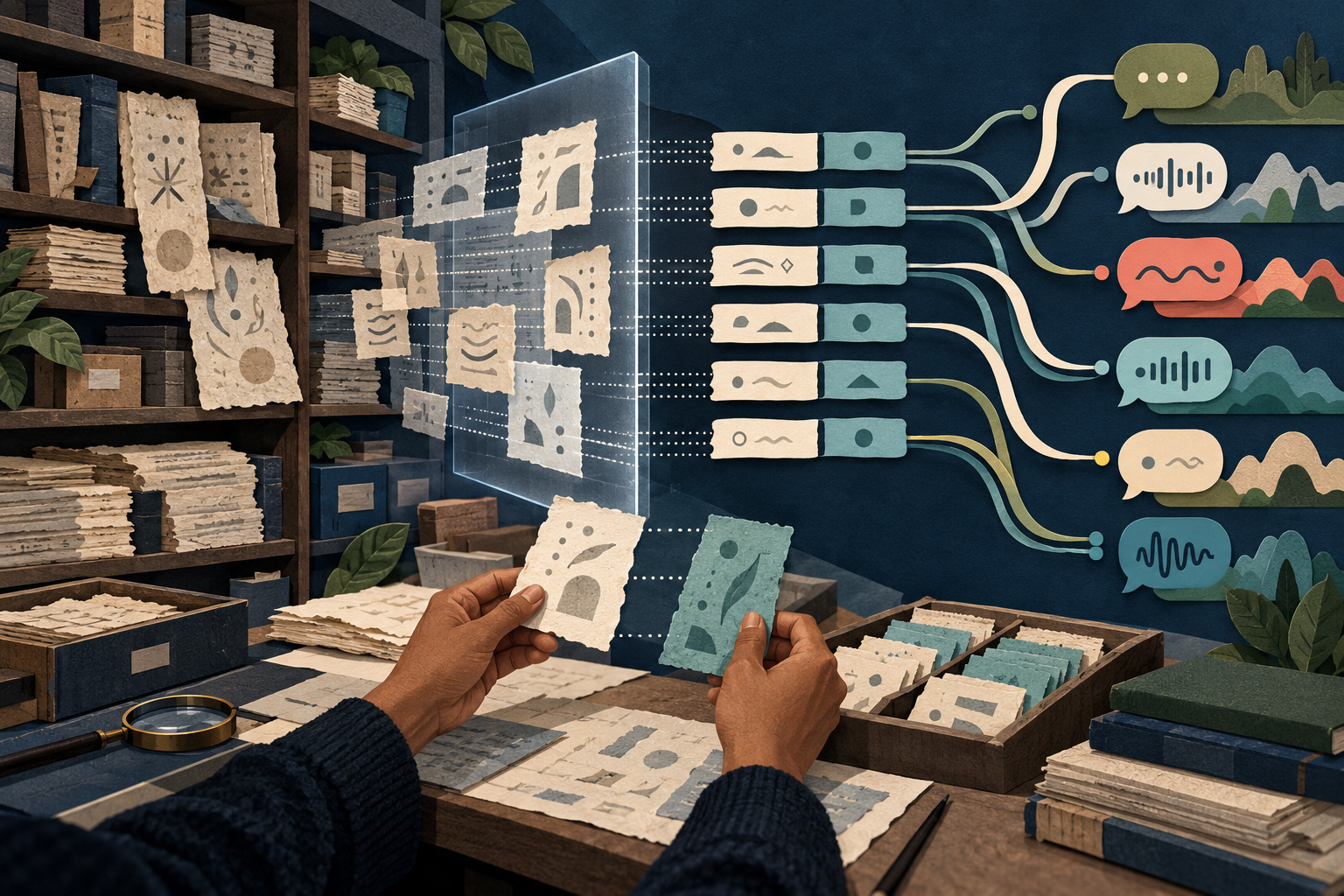
new paper on ‘Mobilizing the Archive’ uses OCR and a visual model to recover parallel examples from digital grammars and dictionaries. The page image matters: the system can see columns, spacing and the relationship between example and translation, rather than relying solely on an OCR line.
Across 20 languages—including Arapaho, Chuvash, Gitxsan, Kalamang, Manchu, Natügu, Uspanteco and Wolof—the average yield was 2,578 text pairs per language. The authors report gains of 15.78 chrF2++ points when translating into lower-resource languages, and 6.94 into higher-resource languages, compared with translation without examples.
The result suggests a clear use for old Welsh dialect dictionaries, local terminology lists and grammars that are out of copyright or appropriately licensed. But an archive is not a mine of text without provenance. Historical spelling, an OCR error or a translation from another era can become training ‘truth’ if the page number, year, edition and context are lost.
The project code repository announced by the authors returned 404 when checked on 30 October. The paper is therefore promising, but the pipeline and data licences could not be independently verified during this scan.
More data is not always the answer
controlled study of speech recognition in six African languages adds a useful warning. The authors compared Whisper, MMS and Phi-4 on Dholuo, Kalenjin, Kikuyu, Maasai, Somali and Swahili.
Phi-4 achieved the lowest character error rate in four of the six languages, while Whisper sometimes repeated or invented words. But adding hours or mixing languages did not always help. With MMS, increasing from 150 to 450 hours changed error by just 0.7 points on average. Monolingual training won 10 of the 12 model–language comparisons.
That does not prove a monolingual Welsh model would be best. It proves the experiment needs controls. A Welsh-only adapter, an adapter warmed up with Celtic languages, and Welsh–English training could be compared on the same test set. Data, compute time and scoring should remain the same.
Three small pilots worth more than a grand claim
Three Welsh pilots follow from this week's evidence:
- build a pronunciation judge from an authoritative lexicon, and test it with listeners on mutations, place names, dialects and code-switching;
- record a benchmark of spontaneous voice requests from Welsh speakers, separating transcription, content, voice and latency;
- extract a small sample from a historical grammar or dictionary, retaining the page, edition, rights, spelling and OCR confidence with every pair.
None would be a grand launch. They would be better: small, open tests that others can inspect and repeat.
A model that can generate a Welsh sentence is a start. A trustworthy Welsh system knows how to pronounce the name, is tested on real speech, and can show where its knowledge came from.
Timing note: the scan was completed at 12:09 GMT on 30 October 2026. Material published later that day will be considered in the next scan.